
By Dominic Ellis September 27, 2026
The cost of switching merchant accounts is rarely just an early termination fee. A transition can include overlapping monthly charges, gateway and PCI fees, minimums, annual charges, equipment obligations, implementation costs, chargebacks, and later adjustments. The lowest-cost switch usually comes from contract review, anniversary-date planning, written closure terms, and a controlled month-boundary cutover.
Merchant Account Switching Cost Summary
| Cost Category | When It Appears | Avoidable? | What to Check |
| Duplicate monthly fee | Transition month | Sometimes | Old and new billing cycles |
| PCI program fee | Account overlap | Sometimes | Processor fee schedule |
| Gateway fee | Parallel testing | Sometimes | Separate gateway contract |
| Monthly minimum | Final old-account month | Sometimes | Signed agreement |
| Early termination fee | Closure | Sometimes | Term, renewal, notice clause |
| Annual/semiannual fee | Around billing cycle | Sometimes | Historical statements |
| Equipment/software | After processing moves | Depends | Separate agreements |
| Chargebacks | After closure | Usually not | Trailing liability terms |
| Reserve retention | After closure | Depends | Reserve provisions |
The practical budgeting window is not merely the day you switch terminals. For a controller or CFO, it is usually the final 30–90 days of the old relationship and the first 30–90 days of the new one.
What Is the Real Cost of Switching Merchant Accounts?
The cost of switching merchant accounts is the sum of contractual exit charges, intentional overlap, final-period fees, implementation expenses, and later liabilities, reduced by any guaranteed credits or reimbursements.
A useful budgeting model is:
Total Switching Cost = Old Account Closure Costs + Duplicate Transition Costs + New Setup Costs + Trailing Charges – Guaranteed Credits/Reimbursements
This is a planning formula, not a card-network or processor formula.
Before calculating it, separate costs into seven buckets: contractual exit cost, duplicate transition cost, final-period usage cost, trailing liability, recoverable or negotiable cost, one-time implementation cost, and overlap that looks avoidable but is operationally prudent.
Before calculating transition expenses, identify the full cost structure of the merchant account, including recurring account charges, gateway costs, hardware obligations, annual fees, and transaction-level expenses. Those costs establish the baseline needed to separate normal processing expense from costs created specifically by the switch.
Every Fee That Can Hit During the Transition Window
The following costs do not apply to every merchant. The signed agreement, addenda, gateway contract, equipment documents, fee schedules, and actual statement history determine what applies.
Every Transition-Window Cost
| Cost | Why It Can Appear | Main Document to Check |
| Old monthly account fee | Account remains open through billing date | Merchant agreement |
| New monthly account fee | Replacement account begins billing | New fee schedule |
| PCI program charge | Processor program remains active | Processor fee schedule |
| Gateway overlap | Both gateways operate temporarily | Gateway agreement |
| Monthly minimum | Old volume falls after cutover | Pricing schedule |
| ETF | Cancellation occurs within applicable term | Termination clause |
| Annual fee | Billing date occurs before effective closure | Statements + fee schedule |
| Network/pass-through cost | Transactions still run on old account | Final statement |
| Equipment charge | Lease/rental survives processing change | Equipment contract |
| Integration cost | New POS/gateway/API work | Vendor proposal |
| Chargeback/adjustment | Old transactions remain disputable | Agreement + network rules |
| Reserve movement | Processor retains or releases funds | Reserve provisions |
Duplicate Monthly Account Fees
Double fees switching processors often start with something mundane: the old provider produces one final monthly service or statement charge while the new account has already begun billing.
That is not automatically a mistake. Canceling the old account before the replacement account has completed underwriting, production testing, and settlement verification can create a much more expensive failure.
Duplicate PCI Fees
PCI DSS and processor PCI-program fees must be kept separate.
PCI SSC states that PCI DSS applies to entities involved in payment processing and that outsourcing payment handling does not automatically eliminate a merchant’s compliance responsibilities. It also tells merchants to confirm validation obligations with the organizations managing their compliance program.
A processor’s monthly PCI program charge, annual compliance charge, or PCI non-compliance fee, however, is a separate commercial matter. Do not describe every line labeled “PCI” as a fee imposed directly by PCI SSC.
Outsourcing payment processing also does not automatically eliminate a merchant’s PCI responsibilities. The PCI Security Standards Council explains that merchants can retain PCI DSS responsibilities even when payment functions are outsourced, while the specific method used to validate compliance is generally determined by the applicable acquirer or other compliance-accepting entity.
Duplicate Gateway Fees
A merchant may temporarily pay two gateway bills when the replacement environment must be tested while the old gateway remains available.
That overlap can also occur during token migration, recurring-billing conversion, ecommerce testing, or a POS software transition. Confirm whether the gateway is bundled into the merchant agreement or governed by a separate contract.
When reviewing the final months of the old account, separate interchange and network costs from merchant-service fees that may be buried in recurring or miscellaneous statement lines. Gateway charges, account fees, PCI-program charges, minimums, and closure-related costs may follow different billing rules and should not be grouped together as interchange.
Monthly Minimums
A monthly minimum merchant account provision can become expensive precisely when transaction volume leaves the old processor.
For example, the merchant may move most sales on the fifth day of the month but leave the old account administratively open through month-end. Whether that triggers a minimum depends on the agreement.
A monthly minimum is also not necessarily the same as a flat minimum service charge. Read the processor’s definition and calculation method.
Early Termination Fee
An early termination fee merchant account provision may be structured as a fixed amount, a remaining-months calculation, liquidated damages, or another contract-specific formula. Some agreements have no ETF at all.
Real agreements demonstrate why assumptions are dangerous. One published merchant agreement uses a formula tied to recent processing fees and months remaining, while another published agreement describes a different remaining-term damages formula.
Those examples are evidence of variability—not estimates of what your own processor may charge.
Annual or Semiannual Fees
Annual account, membership, PCI-program, regulatory-program, statement-management, and similar charges can distort the economics of a switch.
Review at least one full billing cycle where available. A charge that appears only once every 12 months will be invisible if the comparison uses three ordinary statements.
Network and Pass-Through Fees
Do not assume that two open merchant accounts automatically mean duplicated interchange or network assessments.
Transaction-based network costs generally follow transactions actually processed. By contrast, a processor may have separate account-level charges with names referencing networks, platforms, or programs.
Before attributing a higher final statement to the processor, determine whether the account uses interchange-plus or a bundled pricing structure that combines underlying costs with processor markup.
That distinction makes it easier to identify which charges actually changed because of the transition and which simply followed the transactions processed during the final billing period.
Equipment Costs
The processor relationship and equipment agreement may be two different obligations.
Check for terminal rental, equipment lease payments, hardware balances, return deadlines, lost-device charges, cellular subscriptions, and proprietary hardware that cannot be reused.
Before closing the processing account, review whether the business has a separate credit-card terminal lease or equipment agreement that can continue independently of merchant processing. Moving transactions to a new processor does not by itself establish that a separately contracted rental, lease, cellular plan, or hardware obligation has ended.
Software and Integration Costs
New gateway configuration, POS licensing, API work, token migration, recurring-billing conversion, ecommerce plugins, and developer testing are genuine processor transition costs even though they are not processor fees.
Keep them in the financial model. Otherwise, an apparently attractive merchant processing savings calculation understates the cash required to move.
Expert Insight: [Insert a quote from a payments consultant, merchant CFO, processor-contract specialist, or merchant-statement analyst about budgeting the final old-processor month separately from the new pricing comparison.]
Why One Overlap Month Can Be the Cheapest Option
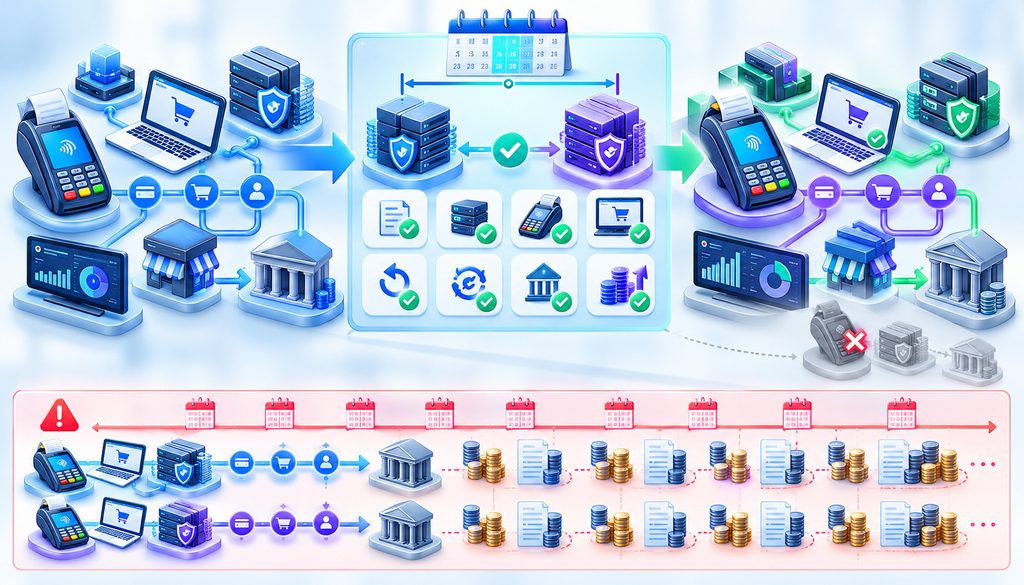
Paying two providers briefly can cost less than forcing a premature cutover.
The new merchant account should generally complete underwriting, receive production credentials, settle a successful test transaction, confirm the correct settlement bank, and demonstrate that critical terminal, gateway, refund, ecommerce, and recurring-payment functions work before the old path is retired.
Necessary overlap is a transition-control cost. Unplanned overlap is waste.
The objective is therefore not necessarily zero overlap. It is the shortest economically sensible overlap that protects revenue and settlement.
When to Time a Processor Switch

The best answer to when to time processor switch is: build the date from the contract and billing calendar, not from the new salesperson’s preferred installation date.
Best Timing Factors for a Processor Switch
| Timing Factor | What to Identify | Why It Matters |
| Contract anniversary | Start/end date | May affect termination cost |
| Auto-renewal | Renewal date and term | Missing notice can alter exit terms |
| Notice window | Deadline and delivery method | Determines effective cancellation |
| Annual-fee month | Historical posting date | Can change short-term economics |
| Statement boundary | Batch and billing cutoff | Simplifies reconciliation |
| Seasonal volume | Lower-risk operational period | Limits disruption exposure |
| New-account readiness | Approval/testing/funding | Prevents premature closure |
Contract Anniversary Date
Find the original term, processor contract anniversary date, current renewal term, auto-renewal language, and notice deadline.
Do not calculate from the date the salesperson remembers. Use the executed agreement and subsequent amendments.
Cancellation-Notice Window
A contract might require advance written notice. A 30-, 60-, or 90-day period should be treated only as an example unless your agreement actually says so.
Also distinguish the notice date from the effective cancellation date.
Annual-Fee Billing Month
Search 12 months of statements, or the longest available full annual cycle, for fees that recur on only one statement.
Moving a planned switch by several weeks may avoid a scheduled annual charge—or may accomplish nothing if the fee was already contractually earned and non-refundable.
Month-End Statement Cycle
A cutover near a clean billing boundary can simplify deposit matching, fee attribution, chargeback tracking, and accounting close.
It is an operational convenience, not a universal legal requirement.
High-Volume Season
If timing is flexible, avoiding the merchant’s most critical sales period can reduce the financial consequences of a cutover problem.
The relevant question is not “Which month is universally best?” It is “Which available window produces the best combination of contract economics and operational control?”
The Auto-Renewal Trap
Auto-renewal matters because a merchant can stop wanting the service before the contract has reached the point at which cancellation becomes economical.
Identify the initial term, renewal term, deadline for non-renewal, required recipient, notice address or portal, acceptable delivery method, and required cancellation language.
A published merchant agreement, for example, can include a defined term, renewal provisions, and early-termination economics. That does not mean your agreement contains the same provisions; it demonstrates why the merchant’s own signed contract must control the analysis.
“My salesperson said I can cancel anytime” is not the same statement as “the signed contract states month-to-month with no termination charge.”
If a verbal promise conflicts with the agreement, request written clarification. For disputed or high-dollar provisions, consider having counsel review the documents.
Get the Closure Terms in Writing Before You Cut Over
Before submitting the payment processor cancellation notice, ask the old provider to confirm:
- Required cancellation method and notice period.
- Effective cancellation date.
- ETF or liquidated-damages amount, if any.
- Annual or semiannual charges still scheduled.
- Minimum monthly charges.
- Separate gateway cancellation procedure.
- Equipment return instructions.
- Equipment lease status.
- Reserve balance and applicable terms.
- Chargeback handling after closure.
- Expected final statement date.
- Expected final ACH debit timing.
- Ability to issue refunds after processing stops.
- Contact information for later disputes and adjustments.
A neutral question is: “Please identify all fees and continuing obligations that could remain between our final processing date and completion of account closure, and cite the applicable agreement or fee-schedule provision.”
Order of Operations for a Low-Cost Processor Switch
- Pull the signed merchant agreement, application, addenda, program guide, and fee schedules.
- Identify the term, renewal date, anniversary date, and notice deadline.
- Review a full annual statement cycle where available.
- Estimate contractual exit and overlap charges.
- Apply for the replacement account.
- Complete underwriting before shutting down the current processor.
- Configure and test the replacement environment.
- Confirm authorization, settlement, and first funding.
- Schedule production cutover.
- Stop sending new transactions through the old account.
- Reconcile the final old batches.
- Submit cancellation using the contractually required method.
- Retain delivery evidence and obtain closure confirmation.
- Audit the final statement.
- Continue monitoring authorized trailing activity, disputes, reserves, and promised credits.
Canceling first and applying second can turn a manageable transition expense into lost sales, emergency integration work, or dependence on an account that has not yet passed underwriting.
What Should the Final Statement From the Old Processor Contain?

A final statement of the old processor audit should explain what was processed, what was contractually billed, and what adjustments were taken before closure.
Final Statement Audit Table
| Statement Line | Audit Question |
| Final processing volume | Does it match the last batches? |
| Interchange/pass-through | Does it correspond to actual activity? |
| Processor markup | Does pricing match the agreement? |
| Monthly fees | Was the account still billable? |
| Monthly minimum | How was it calculated? |
| PCI-related charge | Compliance obligation or processor program fee? |
| Gateway charge | Bundled or separately contracted? |
| Annual charge | Did its billing date precede closure? |
| ETF/termination | What clause authorizes it? |
| Chargeback/inquiry fees | Which prior transaction triggered them? |
| Refund adjustments | Do they match merchant records? |
| Reserve movement | Withholding, debit, or release? |
| Equipment charge | Which equipment agreement applies? |
The final merchant processing statement may not be the final financial event. A later ACH debit, merchant account closure statement, reserve release, chargeback, correction, or residual processor charge may still occur.
Why the Old Merchant Account May Still Matter After Closure
Stopping new payment acceptance does not erase obligations connected with transactions processed earlier.
Stopping new transactions does not eliminate the dispute process for sales already completed. Visa describes a dispute as a process in which an issuer questions transaction value through the acquirer, and merchants may need to review the original transaction and submit supporting records through that acquirer. The current Visa dispute-resolution guidance explains this issuer-acquirer-merchant process.
Mastercard likewise publishes a current merchant chargeback guide and merchant-facing rules documentation.
That is why old processor chargebacks after closure, reversals, representments, reserve movements, settlement corrections, and account adjustments should be modeled as trailing liability.
Do not assume a universal number of months. Exposure depends on the transaction, dispute reason, applicable network rules, merchant agreement, and reserve provisions.
Chargebacks After You Stop Processing
Three events should not be confused:
- You stop sending new transactions to the old processor.
- The merchant account becomes administratively closed.
- Contractual liability for transactions processed before closure ends.
These may occur at different times.
Review which settlement account the provider may debit, whether a reserve can be maintained, what happens if available funds are insufficient, and what contractual collection rights survive termination.
Do not close the old settlement account merely to obstruct contract-authorized debits. Coordinate banking changes only after understanding legitimate trailing obligations.
Annual Fee Clawbacks and Cancellation-Month Surprises
The phrase annual fee clawback merchant account is often used too broadly.
A post-notice charge may instead be an annual fee that posted before the effective cancellation date, a fee that became contractually due once its billing date passed, a non-refundable program charge, a prorated or non-prorated fee, or a separate termination charge.
Consider this illustrative timeline only:
| Event | Hypothetical Date |
| Notice deadline | October 1 |
| Annual-fee posting date | October 15 |
| Contract anniversary | November 1 |
| Planned cutover | October 20 |
| Effective cancellation | November 1 |
If valid notice had to arrive before October 1, waiting until October 20 to investigate the contract could materially change the result. Conversely, moving the technical cutover earlier would not necessarily erase a fee already earned under the contract.
The controlling question is what the agreement and billing terms say.
Account Closure Fees vs Early Termination Fees
Account closure fees and an ETF are not necessarily the same charge.
Potential exit expenses include:
- Early termination fee.
- Account closure fee.
- Deconversion fee.
- Gateway cancellation charge.
- Equipment-return charge.
- Lease termination balance.
- Software cancellation fee.
An older published TSYS merchant agreement, for example, separately described damages calculations and an account-closure component, illustrating why merchants should inspect exact contract terminology instead of calling every exit charge an ETF.
Worked Example: What the Transition Month Actually Costs
The following numbers are illustrative only, not industry averages.
Assume a merchant processes approximately $80,000 per month and expects the new arrangement to reduce ongoing processing expense by $275 per month.
Illustrative Transition-Cost Calculation
| Item | Illustrative Cost |
| Duplicate old monthly fee | $35 |
| Old gateway month | $25 |
| Old PCI-program fee | $20 |
| Final monthly minimum | $40 |
| ETF | $300 |
| Annual fee posting in transition period | $120 |
| New setup/integration work | $400 |
| Gross transition cost | $940 |
| Less written new-provider credit | ($250) |
| Net transition cost | $690 |
Monthly savings after migration = $275
Break-Even Months = Net Transition Cost ÷ Monthly Processing Savings
$690 ÷ $275 = 2.51 months
Again, none of these fee amounts should be treated as typical pricing. Replace every number with the merchant’s actual contract, statements, invoices, and written replacement-provider offer.
How to Compare Transition Cost Against First-Year Savings
Do not evaluate the switch using transition month alone.
Use:
First-Year Net Savings = 12-Month Expected Processing Savings – Net Switching Cost
Using the illustrative numbers above:
12 × $275 = $3,300 expected annual processing savings
$3,300 – $690 = $2,610 first-year net savings
An optional business metric is:
First-Year ROI = First-Year Net Savings ÷ Net Switching Cost
$2,610 ÷ $690 = 3.78, or approximately 378%
That ROI is simply illustrative business math.
A costly first month can still produce sound economics when verified recurring savings recover the transition cost quickly. The reverse is equally important: an attractive monthly savings quote may be uneconomic if contract exit, equipment, integration, and annual-fee exposure consume most of the expected benefit.
What a New Provider May Sometimes Offset
Replacement providers sometimes offer transition incentives, but they are not interchangeable.
Own Cost vs New-Provider Offset
| Transition Cost | Possible Offset | What to Verify |
| ETF | Reimbursement or credit | Maximum and documentation |
| Setup fee | Waiver | Exact fee covered |
| Terminal purchase | Hardware subsidy | Ownership/term conditions |
| Gateway setup | Fee waiver | Duration |
| Integration work | Assistance/credit | Scope |
| First monthly fee | Temporary waiver | Start/end dates |
| Equipment obligation | Buyout contribution | Exact amount and conditions |
A credit is not necessarily cash reimbursement. A free terminal is not the same as paying an ETF. An equipment subsidy is not necessarily an actual contract buyout.
How to Ask for a Switch Credit Without Accepting a Vague Promise
Get the incentive in writing and verify:
- Exact guaranteed amount.
- Which old-provider fees qualify.
- Documentation required.
- Cash reimbursement versus statement credit.
- When payment or credit posts.
- Maximum reimbursement.
- New term commitment, if any.
- Repayment obligation if the merchant leaves.
- Hardware-subsidy conditions.
- Whether the offer applies per location or per MID.
A switching credit should be valued at what the written terms guarantee, not what the salesperson verbally describes.
Double Fees Switching Processors: Which Ones Are Worth Paying?
Some duplicate costs purchase a safer transition. Others usually indicate weak planning.
| Overlap Cost | Sometimes Necessary? | Potentially Avoidable? | Reason |
| One old account month | Yes | Partly | Controlled cutover |
| Second gateway month | Yes | Partly | Testing/token migration |
| Two terminal subscriptions | Yes | Often | Device staging |
| Duplicate PCI program charge | Less often | Often | Billing timing |
| Duplicate annual fee | Rarely | Often | Anniversary planning |
| Two monthly minimums | Rarely | Often | Cutover/billing timing |
Do not automatically eliminate an overlap expense if doing so creates a greater operational risk.
The Statement Audit Before You Give Notice
Review several months and preferably one full annual billing cycle where records are available.
Look for annual and quarterly charges, PCI lines, statement fees, gateway costs, monthly minimums, equipment charges, software subscriptions, adjustments, network-related lines, reserve deductions, and unusually expensive months.
During the pre-cancellation audit, isolate payment-processing statement fees that sit outside ordinary transaction costs. A recurring miscellaneous charge, annual assessment, gateway expense, or processor-added fee can otherwise disappear inside the overall effective rate and be missed when estimating the final old-processor month.
A three-month comparison can miss a once-a-year expense completely.
Common Switching-Cost Mistakes
| Mistake | Financial Consequence | Better Approach |
| Cancel before replacement approval | Lost processing capability | Approve/test replacement first |
| Miss renewal notice | New contractual exposure | Calendar notice deadline |
| Assume ETF is the only exit cost | Underbudget transition | Audit all linked agreements |
| Forget gateway cancellation | Residual billing | Cancel separately if required |
| Ignore equipment lease | Continued payments | Review equipment contract |
| Switch around annual-fee date blindly | Avoidable fee exposure | Review statement history |
| Analyze only three months | Miss annual charges | Review full cycle |
| Trust verbal reimbursement | Credit never materializes | Get written terms |
| Close bank account too early | Collection/reconciliation issues | Resolve trailing liabilities |
| Ignore chargebacks | Surprise debits | Maintain dispute process |
| Skip final statement | Billing errors go unnoticed | Audit every line |
| Leave both accounts active indefinitely | Unnecessary double fees | Set closure milestone |
Merchant Account Switching Cost Checklist
Before Applying
- Pull signed merchant agreement and application.
- Pull addenda and current fee schedules.
- Identify processor contract anniversary date.
- Identify merchant account auto renewal terms.
- Find notice deadline and delivery method.
- Identify separate gateway, equipment, and software contracts.
- Review a full year of statements where possible.
Before Cutover
- Obtain replacement-account approval.
- Complete production testing.
- Test settlement/funding.
- Calculate expected overlap.
- Confirm annual-fee exposure.
- Price ETF and account closure fees.
- Get new-provider credits in writing.
During Cutover
- Move production batches to the replacement account.
- Record the final old-processor transaction and batch.
- Reconcile deposits.
- Submit cancellation using the required method.
- Preserve delivery evidence.
After Cutover
- Obtain written closure confirmation.
- Review the final statement old processor issues.
- Watch for legitimate residual ACH debits.
- Retain old agreements and statements.
- Monitor chargebacks and reserves.
- Verify promised switch credits.
- Investigate unexpected statement fees after account cancellation.
Frequently Asked Questions
How much does it usually cost to switch merchant accounts?
There is no reliable universal amount. Calculate your own cost from exit charges, overlap, final-period fees, implementation expenses, trailing liabilities, and guaranteed credits.
Will I pay two processors in the same month?
Possibly. One overlap month can be intentional when the replacement account is live and being verified before the old processing path is retired.
Should I cancel my old merchant account before applying for the new one?
Generally, the replacement account should be approved and tested first, subject to your agreement and operating circumstances. Underwriting is not guaranteed merely because a merchant already processes elsewhere.
Can my old processor charge an annual fee after I give notice?
Potentially. The answer depends on the fee’s billing date, effective cancellation date, refundability, and contract wording. Giving notice and reaching the contractual closure date are not necessarily the same event.
What should I look for on the final statement?
Reconcile final volume, processor markup, pass-through charges, monthly fees, minimums, PCI and gateway lines, annual charges, termination costs, chargebacks, refunds, reserves, equipment costs, and adjustments.
Can chargebacks hit after the account closes?
Yes, transactions processed before closure can remain subject to later disputes under applicable network procedures and contractual terms. Visa and Mastercard maintain merchant dispute frameworks, so administrative closure should not be treated as erasing prior transaction liability.
Does an early termination fee include my equipment lease?
Not necessarily. Equipment leasing, POS software, gateway service, and merchant processing can be governed by separate agreements.
Can a new processor reimburse my ETF?
Some providers may offer a reimbursement or statement credit. Evaluate only the written amount, conditions, documentation requirements, timing, and any new commitment attached to it.
What is the best time of month to switch processors?
A clean statement boundary can make reconciliation easier, but the contract calendar matters more. Consider notice deadlines, anniversary dates, annual-fee dates, operational seasonality, and replacement-account readiness together.
How long should I keep old processor statements?
Retain them long enough to support accounting, tax, contract, chargeback, reconciliation, and dispute needs under your applicable record-retention policies. Do not assume a universal merchant-services retention period; coordinate the schedule with your accountant, counsel, and any applicable regulatory requirements.
Calculate the Switch Before You Sign the New Deal
The cost of switching merchant accounts should be a line-by-line financial model, not a surprise discovered after the first new statement arrives.
Price the contract exit, planned overlap, annual-fee timing, final statement exposure, equipment and software obligations, trailing liability, and every written new-provider credit. Then calculate how many months of verified recurring savings are required to recover that cost.
Also perform a contradiction check before giving notice: proposal versus signed agreement, agreement versus program guide, current versus historical fee schedules, cancellation versus renewal language, historical annual-fee pattern, gateway versus merchant agreement, equipment lease versus processing contract, and closure confirmation versus later statement activity.
Where documents disagree, identify the controlling agreement where possible and request clarification in writing rather than assuming the sales presentation overrides the executed contract.
The cheapest processor switch is not necessarily the one with zero transition cost. It is the one where the merchant knows the transition cost in advance and can show that the expected savings exceed it within an acceptable period.
Leave a Reply