
By Dominic Ellis September 26, 2026
A fair interchange plus markup by volume generally becomes more competitive as monthly card volume rises, but no single markup is universally fair. The processor’s “plus” usually includes basis points and a per-transaction charge. Average ticket, transaction count, sales channel, risk, card mix, and fixed fees all affect the economics, so compare total markup dollars—not one headline number.
| Monthly Card Volume | What Usually Matters Most | Basis-Point Sensitivity | Per-Item Sensitivity | Fixed-Fee Sensitivity | Negotiation Focus |
| Around $10,000 | Keeping total account overhead proportionate | Moderate | High for low-ticket merchants | Very high | Remove unnecessary fixed fees and minimums |
| Around $50,000 | Balancing percentage and per-item markup | High | Moderate to high | Moderate | Negotiate both components and gateway costs |
| Around $250,000 | Small basis-point differences become large dollars | Very high | High if transaction count is large | Low relative to volume | Custom pricing, volume reviews, written step-downs |
These are economic patterns, not regulated pricing bands. They are better used as a processing markup by the monthly volume framework than as a universal rate card.
Public pricing illustrates why volume matters. One current U.S. provider publishes different processor margins for different monthly-volume bands and separates in-person from keyed and online pricing. That is useful evidence that processor economics can change with scale, but one provider’s public schedule should never be treated as the universal definition of fair pricing.
Visa and Mastercard’s official documentation also shows why interchange should not be confused with processor margin. Their U.S. interchange structures contain numerous programs and qualification categories rather than one universal wholesale percentage. Mastercard further states that it is not involved in the pricing agreements established between acquirers and merchants.
Before benchmarking the processor’s margin, make sure the quote actually uses interchange-plus rather than tiered pricing. Tiered pricing can bundle transactions into processor-defined categories, while interchange-plus makes it easier to isolate the underlying interchange cost from the provider’s stated percentage and per-item markup.
The “Plus” Has Two Parts: Basis Points and Per-Transaction Markup

A typical interchange-plus quote can be expressed as:
Interchange + X basis points + $Y per transaction
Twenty basis points means 0.20%. A $0.10 per-item markup means the processor adds ten cents for each transaction.
Those two components behave differently. The basis-point markup scales with sales dollars, while the processor markup per transaction scales with transaction count.
The basic formula is:
Monthly processor markup = (monthly volume × basis-point markup) + (transaction count × per-item markup) + fixed processor fees
If a merchant processes $50,000 at 20 basis points, the percentage component equals:
$50,000 × 0.20% = $100
If it also processes 1,000 transactions at $0.10 each:
1,000 × $0.10 = $100
Before monthly fees, the processor markup is therefore $200.
This calculation intentionally excludes true interchange and network pass-through charges. When you are establishing an interchange plus basis points benchmark, the goal is to isolate what the provider is adding rather than quietly mixing network costs into processor margin.
That distinction is also useful when evaluating cost plus pricing for a small business. Two merchants can receive exactly the same percentage-and-cents quote but experience very different effective processor costs because one may run hundreds of transactions while the other runs thousands.
Fair Interchange Plus Markup by Volume: A Better Benchmark Framework
There is no regulated fair interchange plus markup by volume that says a merchant processing $10,000, $50,000, or $250,000 per month must receive a specific number of basis points.
Likewise, there is no official interchange plus basis points benchmark published by Visa, Mastercard, or PCI SSC telling processors what margin they may earn.
A more useful question is:
How many dollars does the provider earn from its percentage markup, processor markup per transaction, and account-level fees at this merchant’s actual volume and transaction count?
Public pricing can provide a reference point without becoming a universal standard. One provider currently publishes an in-person margin of interchange plus 0.40% + $0.08 below $50,000 per month, 0.35% + $0.07 from $50,000 to $100,000, and 0.25% + $0.07 from $100,000 to $500,000. Its keyed and online margins differ.
Those numbers are that provider’s public pricing, not regulated rates, promised negotiated pricing, or evidence that another processor must match them.
MCC, underwriting risk, chargeback history, sales channel, gateway architecture, software requirements, equipment, funding requirements, support level, average ticket, contract structure, and other operational factors can all change acquiring economics.
Around $10,000 Per Month
At approximately $10,000 per month, a merchant generates relatively limited gross processor-margin dollars. Fixed account costs can therefore have an outsized effect on the effective markup.
Five basis points on $10,000 is only:
$10,000 × 0.05% = $5
Eliminating a $25 recurring monthly charge saves five times as much.
This is why evaluating cost plus pricing for a small business at lower volume requires more than asking whether 25, 30, or 40 basis points sounds reasonable.
Low-ticket businesses also need to watch the processor markup per transaction carefully. A merchant with a $20 average ticket processes approximately 500 transactions to generate $10,000.
At $0.10 per transaction, that produces:
500 × $0.10 = $50
The per-item component alone can therefore exceed the dollar effect of negotiating several basis points.
A simple card-present retailer may also have different provider economics from a card-not-present merchant that needs a gateway, recurring billing, fraud controls, international acceptance, or more intensive dispute management.
Around $50,000 Per Month
At $50,000 per month, basis-point differences begin to carry greater financial weight.
A 10-basis-point difference equals:
$50,000 × 0.10% = $50 per month
If processing remains consistent, that is:
$50 × 12 = $600 per year
The merchant also produces more processor-margin dollars, which can strengthen its position when it tries to negotiate an interchange plus rate.
But transaction count remains critical.
A $50,000 merchant averaging $25 per transaction processes about 2,000 transactions monthly. A five-cent reduction in processor markup per transaction saves:
2,000 × $0.05 = $100 per month
That is twice the savings created by a 10-basis-point reduction in this example.
The practical lesson is that a useful interchange plus basis points benchmark should never be evaluated without the per-item charge.
Around $250,000 Per Month
At $250,000 per month, small percentage differences become financially significant.
Ten basis points equals:
$250,000 × 0.10% = $250 per month
Over a year of consistent processing:
$250 × 12 = $3,000
At this scale, merchants have a stronger reason to schedule pricing reviews, compare acquiring options periodically, and discuss written volume triggers when negotiating the account.
A business that originally negotiated its fair interchange plus markup by volume while processing $40,000 monthly should not assume the same pricing remains competitive after growing to $250,000.
Fixed charges become proportionally smaller, but they should still be reviewed.
Transaction volume can also remain important. A $250,000 merchant running 500 transactions has completely different per-item economics from a $250,000 merchant running 20,000 transactions.
$10K vs. $50K vs. $250K: Hypothetical Markup Examples
The following figures are illustrative examples—not promised merchant rates.
They show how processing markup by monthly volume changes as volume, average ticket, transaction count, basis points, and fixed fees change.
| Metric | $10K Merchant | $50K Merchant | $250K Merchant |
| Monthly volume | $10,000 | $50,000 | $250,000 |
| Average ticket | $50 | $100 | $250 |
| Transactions | 200 | 500 | 1,000 |
| Basis-point markup | 40 bps | 30 bps | 20 bps |
| Per-item markup | $0.08 | $0.08 | $0.06 |
| Fixed monthly fees | $25 | $30 | $40 |
| Percentage markup dollars | $40 | $150 | $500 |
| Per-item markup dollars | $16 | $40 | $60 |
| Total processor markup | $81 | $220 | $600 |
| Effective processor markup | 0.81% / 81 bps | 0.44% / 44 bps | 0.24% / 24 bps |
| Main negotiation priority | Fixed fees | Both markup components | Basis points + volume reviews |
The calculations reconcile as follows.
For the $10,000 merchant:
$40 + $16 + $25 = $81
$81 ÷ $10,000 = 0.81% = 81 basis points
For the $50,000 merchant:
$150 + $40 + $30 = $220
$220 ÷ $50,000 = 0.44% = 44 basis points
For the $250,000 merchant:
$500 + $60 + $40 = $600
$600 ÷ $250,000 = 0.24% = 24 basis points
Notice that the hypothetical quoted percentage markup falls as volume rises, yet the processor earns more actual dollars.
That is one reason processing markup by monthly volume can become more competitive as a merchant scales without requiring the provider to earn less total revenue from the relationship.
Same Volume, Different Average Ticket
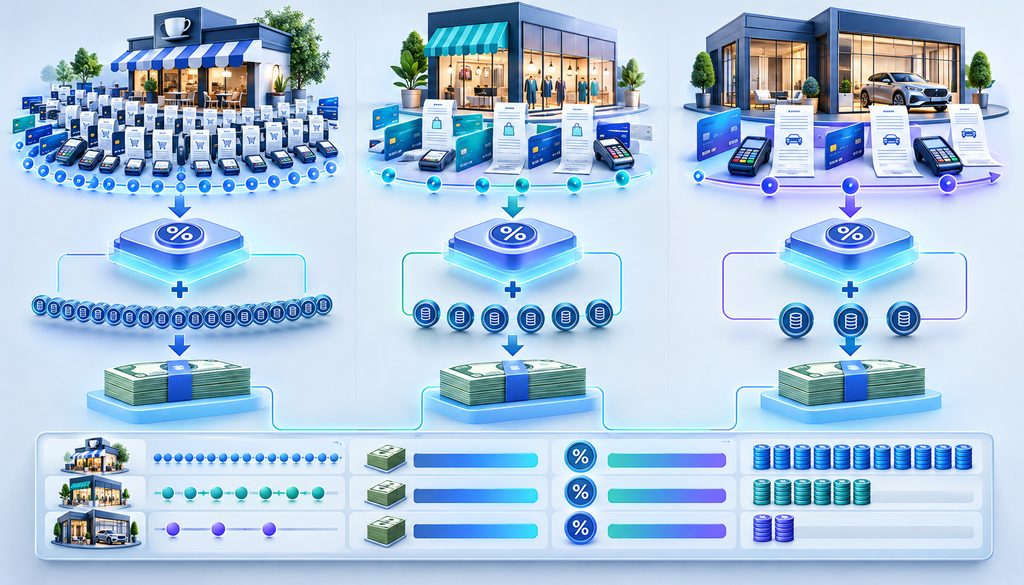
Suppose three merchants each process $50,000 per month and receive the identical processor quote of:
Interchange + 0.30% + $0.10 per transaction
Fixed monthly costs are excluded so the transaction-count effect remains clear.
| Merchant | Monthly Volume | Average Ticket | Transactions | Basis-Point Portion | Per-Item Portion | Total Plus |
| Merchant A | $50,000 | $50 | 1,000 | $150 | $100 | $250 |
| Merchant B | $50,000 | $100 | 500 | $150 | $50 | $200 |
| Merchant C | $50,000 | $500 | 100 | $150 | $10 | $160 |
The basis-point component remains $150 for all three because dollar volume is identical.
The processor markup per transaction changes the result because transaction counts differ.
Merchant A pays $90 more in total “plus” than Merchant C despite processing exactly the same monthly dollar volume.
This illustrates why asking, “What is a fair markup for $50,000 per month?” is incomplete without also asking about average ticket and transaction count.
When Basis Points Matter More—and When the Per-Item Fee Matters More
The simplest way to evaluate a pricing change is to convert both components into dollars.
At $50,000 per month:
10 basis points = $50
Across 1,000 monthly transactions:
$0.05 per transaction = $50
That creates a useful break-even point.
Break-even transaction count = dollar impact of basis-point difference ÷ per-item difference
Using the figures above:
$50 ÷ $0.05 = 1,000 transactions
Below 1,000 transactions, the 10-basis-point change has the greater dollar impact.
Above 1,000 transactions, the five-cent per-item difference becomes more important.
This is why the best way to negotiate an interchange plus rate differs between business models.
High-ticket professional services, jewelry, B2B distribution, and similar merchants may be more sensitive to basis points. Coffee shops, quick-service restaurants, parking operators, convenience stores, ticketing businesses, and other high-frequency merchants can be much more sensitive to the per-item charge.
Average Ticket and Card Mix Affect Different Parts of the Economics
Identical monthly processing volume does not mean identical underlying payment cost.
Card mix primarily affects interchange and network pass-through costs. Transaction count and the merchant’s negotiated pricing structure determine much of the plus.
Visa’s current U.S. interchange documentation contains different programs based on product and transaction characteristics, while Mastercard explains that its interchange tables include numerous qualification criteria and transaction categories.
Relevant differences can include:
- Card-present versus card-not-present transactions
- Consumer debit
- Consumer rewards credit
- Premium credit products
- Commercial cards
- Domestic versus cross-border activity
- Transaction qualification
- Merchant category
- Refund patterns
- Authorization and settlement behavior
Commercial-card transactions can also have different qualification economics when richer transaction data is submitted under applicable programs.
The important distinction is that an expensive rewards card does not automatically justify an arbitrary increase in processor margin.
Under clean interchange-plus pricing, differences in network interchange should remain identifiable as pass-through costs while the agreed processor markup remains a separate component unless the merchant agreement provides otherwise.
When reviewing an existing account, payment-processing statement fees and processor markups should be separated line by line so interchange, network assessments, processor margin, gateway charges, and account-level fees are not treated as one blended cost.
The Fixed-Fee Stack Can Matter More Than Five Basis Points

Headline basis points receive most of the attention during a pricing review, but fixed monthly processing fees can materially change the effective processor markup.
Possible charges include:
- Monthly account fee
- Statement fee
- PCI program fee
- PCI non-compliance fee
- Gateway monthly fee
- Gateway per-transaction fee
- Virtual-terminal fee
- Batch fee
- Account minimum
- Annual fee
- Equipment subscription
- Software subscription
Not every provider charges every fee, and a charge should not automatically be labeled unreasonable merely because it exists.
Some fees pay for actual technology, software, security programs, equipment, or account services. Others may be provider-controlled margin. The key is determining what the charge represents and including comparable costs consistently when evaluating competing quotes.
A PCI-related line item should also be evaluated separately from network interchange and processor transaction markup. PCI SSC states that PCI DSS applies to merchants regardless of size or transaction volume, while compliance-validation requirements are determined by the relevant payment brands or acquirer. Its small-merchant PCI DSS guidance does not establish a universal monthly PCI fee that every merchant must pay.
That means a merchant seeing a PCI-related account charge should ask what service the provider supplies for that fee rather than assuming the dollar amount itself was imposed by PCI SSC.
Consider the equivalent impact of identical monthly fees:
| Fixed Monthly Fee | At $10K Volume | At $50K Volume | At $250K Volume |
| $20 | 20 bps | 4 bps | 0.8 bps |
| $35 | 35 bps | 7 bps | 1.4 bps |
| $50 | 50 bps | 10 bps | 2 bps |
At $10,000 monthly volume, a $35 fixed charge is equivalent to 35 basis points.
A merchant could spend considerable effort negotiating five basis points—worth just $5 monthly at that volume—while overlooking $35 of recurring charges.
At $250,000, the same $35 represents only 1.4 basis points.
This is one reason the economics of a fair interchange plus markup by volume cannot be evaluated through the transaction rate alone.
Fixed monthly charges should be included when calculating the true cost of a merchant account, because statement fees, gateway charges, software costs, minimums, and recurring account fees can materially change the effective markup even when the quoted basis-point rate looks competitive.
How to Calculate Your True Processor Markup
A merchant statement provides a better starting point than a sales proposal.
Use this process:
- Record total processed card sales.
- Identify actual interchange charges.
- Separate card-network assessments and other genuine pass-through network costs.
- Identify the provider’s basis-point markup.
- Identify the processor markup per transaction.
- Add processor-controlled monthly and account fees.
- Add gateway or technology charges when those costs are part of the solution being compared.
- Convert annual or quarterly provider charges to an appropriate monthly amount.
- Divide the comparable processor-controlled cost by processed sales.
For pure processor markup:
Effective processor markup % = total processor markup dollars ÷ monthly processed volume × 100
Then:
Equivalent basis points = effective processor markup % × 100
Therefore:
0.35% = 35 basis points
Do not combine three different metrics.
Pure Processor Markup
This can include the processor’s percentage markup, transaction markup, and processor-controlled account fees.
Total Provider-Controlled Solution Cost
This can include processor markup plus gateway, platform, software, or technology charges required by that provider’s solution.
Total Processing Cost
This adds underlying interchange and network costs to provider-controlled charges.
All three calculations can be useful, but they answer different questions.
If the goal is establishing an interchange plus basis points benchmark, use the first or second measure rather than treating total processing cost as though it were all processor profit.
Why the Lowest Basis-Point Quote May Not Be the Cheapest
Suppose a business processes $50,000 monthly at a $100 average ticket, producing about 500 transactions.
The following proposals are entirely hypothetical.
| Quote | Plus Rate | Per-Item | Monthly Fees | Gateway | Estimated Monthly Markup | Effective Markup |
| Quote A | 0.15% | $0.20 | $79 | $35 | $289 | 0.578% |
| Quote B | 0.25% | $0.08 | $25 | $0 | $190 | 0.380% |
| Quote C | 0.30% | $0.05 | $0 | $10 | $185 | 0.370% |
Quote A advertises the lowest percentage markup but produces the largest total provider-controlled cost under these assumptions.
Quote C carries the highest basis-point markup yet produces the lowest total markup.
That does not prove Quote C would be the best operational choice. Hardware, gateway functionality, contract terms, support, funding, risk tools, and other services still matter.
It demonstrates why comparing only one headline rate can be misleading.
When performing an apples-to-apples analysis, merchants should also confirm that each proposal includes comparable services. A gateway included in one quote but excluded from another can otherwise distort the apparent savings.
When an Interchange-Plus Quote May Warrant Closer Review
A quote deserves deeper analysis when one attractive number receives most of the attention while the remainder of the fee schedule is difficult to identify.
Examples include:
- Very low basis points paired with high per-item charges
- Low “plus” pricing combined with a substantial monthly minimum
- Gateway markup layered onto processor markup without clear disclosure
- Annual fees omitted from the headline comparison
- PCI-related charges without a clear description of the service
- Separate authorization, settlement, batch, or reporting charges that materially change cost
- Pricing described as interchange-plus while some non-pass-through charges are bundled into supposedly wholesale costs
- Different processor-markup tiers hidden behind one headline rate
- Unclear refund treatment
- Unclear American Express treatment
- Processor margin that can increase automatically without a clear contractual mechanism
- A quote that omits the complete fee schedule
The existence of a fee alone does not establish that it is inappropriate.
Evaluate its purpose, disclosure, economic impact, and whether the service is actually part of the solution the merchant needs.
Before signing, compare the quote with the actual merchant-services agreement and its fee provisions, including monthly charges, minimums, annual fees, gateway costs, termination terms, and any clauses that allow pricing to change after activation.
How to Negotiate an Interchange-Plus Rate Without Chasing One Number
The best way to negotiate an interchange plus rate is to arrive with your actual processing economics rather than asking a provider to lower an isolated rate.
Use this checklist:
- Bring two or three recent processing statements.
- Calculate current monthly and annual card volume.
- Calculate average ticket.
- Count monthly transactions.
- Separate processor markup from interchange and network pass-through costs.
- Request basis-point and per-item pricing in writing.
- Request the complete fee schedule.
- Ask whether gateway fees contain additional markup.
- Identify account minimums.
- Ask which rates or fees can change automatically.
- Request an annual volume review.
- Discuss written growth-trigger pricing.
Annual Volume Review
Pricing should be reviewed after meaningful sustained growth rather than assuming a provider will volunteer a reduction.
A merchant that grows from $15,000 to $150,000 in monthly card sales can have very different economics from the account originally underwritten and priced.
That does not guarantee a reduction, but it gives the merchant a legitimate reason to reopen the discussion.
Growth Triggers
A growth trigger creates a documented point at which pricing is reviewed or, if both parties agree, adjusted according to a written schedule.
For example, the agreement could call for a pricing review after the merchant exceeds a defined monthly volume threshold for three consecutive months.
The processor does not have to accept this structure.
Its advantage is that the merchant’s future pricing discussion is tied to measurable growth instead of an informal promise.
Written Markup
Document both parts of the “plus.”
The agreed basis-point markup and processor markup per transaction should appear in the applicable merchant application, pricing schedule, addendum, or other governing documentation.
A sales spreadsheet alone should not override contrary contractual language.
Fee Stability
Ask which fees are fixed, which can change, what can trigger changes, and how notice will be delivered.
A competitive starting rate is less valuable if material elements of the pricing can change shortly after implementation without the merchant understanding the mechanism.
Transaction Growth
Monitor transaction count separately from dollar volume.
A merchant’s revenue might grow 20% while its transaction count grows 50% because it begins selling lower-ticket products.
In that situation, the per-item portion can become increasingly important even if the basis-point markup never changes.
Illustrative Example: High-Ticket B2B Merchant
Assume a professional-services or B2B business processes $100,000 per month through 100 card transactions averaging $1,000.
Reducing the processor markup per transaction from $0.10 to $0.05 saves:
100 × $0.05 = $5 per month
Reducing the percentage markup by 10 basis points saves:
$100,000 × 0.10% = $100 per month
For this merchant, the basis-point component deserves substantially more attention.
This is why a generic cost plus pricing small business comparison that ignores average ticket can produce poor conclusions.
Illustrative Example: Coffee Shop or Quick-Service Merchant
Now assume another merchant also processes $100,000 monthly but has a $10 average ticket.
Transaction count becomes approximately:
$100,000 ÷ $10 = 10,000 transactions
A five-cent per-item reduction saves:
10,000 × $0.05 = $500 per month
A 10-basis-point reduction still saves only $100.
For this merchant, the processor markup per transaction is the larger negotiating variable in this comparison.
Illustrative Example: Growing E-Commerce Merchant
Consider an online seller growing from $40,000 to $200,000 in monthly card volume with a moderate average ticket.
The basis-point markup becomes increasingly significant as dollar volume grows.
But the finance team should also examine gateway transaction charges, recurring-billing costs, fraud tools, account fees, and other technology expenses that may increase with transaction count.
The merchant therefore gains little by negotiating 10 basis points from the acquiring markup if an overlooked gateway charge adds an equivalent or greater amount elsewhere.
The correct objective is the lowest appropriate total provider-controlled cost for the required solution, not the smallest percentage printed on the proposal.
Expert Quote Placeholder: Add a quote from an independent payments consultant, acquiring executive, or merchant-pricing analyst explaining why merchants should compare total markup dollars rather than headline basis points alone.
The scale of U.S. card usage helps explain why relatively small pricing differences matter when multiplied across transaction volume. The Federal Reserve’s 2025 triennial payments study reported 236.6 billion noncash payments in 2024, with cards representing more than three quarters of payments by number.
Frequently Asked Questions
What is a fair interchange plus markup by volume for a small business?
There is no universal fair rate. For smaller merchants, fixed fees and processor markup per transaction can be as important as the percentage markup.
Evaluate the basis-point charge, per-item fee, monthly charges, gateway expenses, average ticket, transaction count, risk, and sales channel together.
The best benchmark is the provider-controlled cost expressed in both dollars and equivalent basis points.
What is a good interchange-plus rate for a small business?
A “good” rate cannot be determined from one number.
Calculate the percentage markup, transaction charges, and fixed provider fees at your actual processing pattern. A seemingly higher basis-point quote can cost less overall if its transaction and account charges are lower.
How many basis points should a processor make?
There is no regulated processor-margin requirement.
Processor economics vary with monthly volume, transaction count, merchant category, risk, sales channel, service requirements, gateway arrangement, contract structure, and other factors.
Focus on total provider-controlled markup rather than assuming every processor should earn the same basis-point margin.
Does interchange-plus pricing get cheaper as volume grows?
It can.
Higher volume often increases negotiating leverage, and some public interchange-plus providers use lower margins at higher processing volumes. That does not mean every merchant is guaranteed an automatic reduction.
Is a lower per-transaction fee better than a lower basis-point markup?
It depends on average ticket and transaction count.
A high-ticket merchant with relatively few transactions will usually be more sensitive to percentage changes. A low-ticket merchant running thousands of transactions can be far more sensitive to a five- or ten-cent processor markup per transaction.
How do I compare two interchange-plus quotes?
For each quote, calculate:
(monthly volume × processor percentage) + (transaction count × processor item fee) + comparable provider-controlled fixed fees
Then divide the result by monthly processing volume. That produces the effective provider markup and allows a true apples-to-apples comparison.
Can I renegotiate interchange-plus pricing after my volume increases?
Yes, you can request a review.
When you negotiate interchange plus rate terms initially, consider asking for annual reviews or written growth triggers so that a future discussion is tied to measurable volume rather than an informal promise.
Fair Interchange Plus Markup by Volume Comes Down to Total Economics
A fair interchange plus markup by volume cannot be reduced to one universal percentage, one processor markup per transaction, or one published market number.
Merchants processing $10,000, $50,000, and $250,000 per month have different cost sensitivities and negotiating leverage.
At $10,000, eliminating $30 of unnecessary monthly overhead can matter more than shaving five basis points from the rate.
At $50,000, both the percentage and per-item components can materially affect the monthly bill.
At $250,000, a difference of only a few basis points can translate into thousands of dollars annually, making regular pricing reviews increasingly worthwhile.
Average ticket is equally important because it determines how many transactions are required to produce the same dollar volume. That transaction count determines the financial effect of the per-item processor charge.
Card mix affects total payment expense primarily through interchange and network costs. It should not be casually mixed into the negotiated “plus” when analyzing processor margin.
The most useful approach to processing markup by monthly volume is therefore:
Total processor markup dollars → effective markup percentage → equivalent basis points
Use that calculation alongside the complete fee schedule, average ticket, transaction count, gateway requirements, service needs, risk profile, and contract terms.
When the business grows, revisit the economics. An annual pricing review or documented growth trigger can help prevent a merchant from remaining indefinitely on pricing established when its processing volume was a fraction of its current level.
That is ultimately the most practical way to establish a fair interchange plus markup by volume: not by chasing one advertised basis-point number, but by measuring how much the entire processor-controlled pricing structure actually costs the business.
Leave a Reply